Showing posts with label RPGs. Show all posts

Thursday, October 8, 2015

Steal This: Honey, I Shrunk the PCs

Did your players just ditch tonight's adventure hook?  Need something to throw at them quick? Well, you're in luck!   

I call this one, "Honey, I Shrunk the PCs."


I inflicted this lil' bit of awfulness on the players last week in my Neverwinter Nights "cloud" game, and it was quite a hit. 

The Setup...

An NPC wizard (preferably someone who has sold the PCs potions or other magical goodies in the past) needs adventurers to test out some new potion recipes.  He'll pay good money - either in potions, magic, or coin, whatever the PCs prefer - if they will come to his tower, drink a few potions, and see what the results are.

In my game, the PCs responded to this "want ad" from their friendly, neighborhood potion dealer...


Once the PCs take the bait, the wizard will walk them a bit away from his tower, and plunk down a chest full of random potions.  To earn their pay, all they have to do is drink 1 potion and answer a few questions.  

For my own game, I used this table to randomly determine the effect of drinking a potion. 

Random Potion Effects - Roll 1d20

1-6, Potion is a "dud."  No effect at all, beyond a bit of mild stomach discomfort and some gas.

7-8, Bioluminescence.  The drinker's body glows with an unhealthy orange light.  Not painful, but grants Disadvantage (in D&D 5e) or a penalty of the GM's choice (in other systems) on all Stealth checks.  The effects last 1 day.

9, Speak with Animals.  The drinker naturally understands and can communicate with any natural animal or insect.  This doesn't make the animals or insects any smarter, but crude communication and rudimentary bargaining is possible.  The effects last 1 day.

10, Philter of Hair Regrowth.  If the drinker suffers from baldness, this is permanently cured.  Either way, all of the drinker's hair immediately grows 2d6 inches, and another 2d6 inches each hour.  The cure for baldness is permanent, the other effects fade after 1 day. 

11, Philter of the Rake. The drinker becomes incredibly handsome or beautiful and nigh-irresistible in the romance department. Gain Advantage on all social rolls with anyone attracted to the drinker's sex.  The effects last 1 day.

12, Draught of Absolute Honesty.  No apparent effect, but the drinker becomes unable to tell lies, or say anything but the absolute, complete truth.  Attempts to lie or mislead in any way wrack the drinker with choking fits and agonizing pain (1d6 hp per attempt).  The effects last 1 day.

13, Potion of Rhyming.  The drinker becomes unable to speak except in rhyming couplets.  If the drinker affirmatively tries to speak without rhyming (such as trying to cast a spell), he or she takes 1d6 hp and the attempt fails.

14, Potion of Premature Aging.  The drinker suddenly advances to incredible old age, and gains Disadvantage on all physical ability or skill checks (including attacks).  The effects last 1 day.

15-16, Treant's Draught.  The drinker's skin becomes as tough as bark, and he or she gains an inherent +2 to AC. The effects last 1 day.

17-18, Potion of Partial Invisibility.  The drinker's body (but not his or her equipment) fades into invisibility.  No game effect (but may weird some people out and impose penalties on social checks).  If the character sheds all clothing and equipment, he or she gains the benefits of the Improved Invisibility spell.  The effects last 1 day.

19-20, Trollblood Potion.  The drinker suddenly begins regenerating, as per a Troll.  Even death will not stop the drinker from regenerating and returning to life.  The effects last 1 day.

It's a Small World After All

After the PCs finish drinking their potions, the NPC wizard happily pays them their reward and takes his leave - walking back to his tower nearby. 

A few minutes after that, all of the PCs who drank a potion begin to feel a bit light-headed.  And, one by one, they begin "vanishing" in a flash of light, as each one shrinks down to 1 inch tall - about the same size as a D&D mini...

"Is it just me, or did the grass get really tall all of the sudden..."

Now, if the PCs want to return to their normal size, they need to trek back to the NPC Wizard's tower, get his attention, and persuade him to reverse the effect.

GM NOTE ON SMART OR PARANOID PLAYERS:  You should really push all of the PCs to sample the potions.  Feel free to keep upping the rewards until it becomes too tempting to resist.  Or, if a player is particularly stubborn, have the NPC wizard elect him to help clean up the vials or hold some of the potions - and then just accidentally slop a little potion on him that way.  Of course, very paranoid or clever PCs may be able to avoid this adventure entirely - but that's the breaks. Give him a Spot check to find his "vanished" fellows and, if he fails it, I guess he spends  this game back at the tavern wondering where they went...

Miniature Terrors!

The PCs will quickly discover that their "tiny adventure" is no picnic.  Normal animals and bugs will find the PCs to be a delectable and "bite sized" feast! 

Trekking through the woods, they may face hungry frogs...


A pixie that is eager to get a little payback on the stupid humans who normally torment her (she's several times their size, and excited to be the big bully for once...)


A stray cat is the size of a dragon, but not as nice...


Hordes of pigeons or hungry seagulls can peck the PCs to death...


And, once the PCs manage to get back into the NPC wizard's tower, more danger awaits!  Of course there are plenty of spiders in the tower, eager for a meal...


The PCs may "need a hand" with the NPC Wizard's Crawling Claw...


The wizard's dog seemed cute and friendly before, but not so much now...
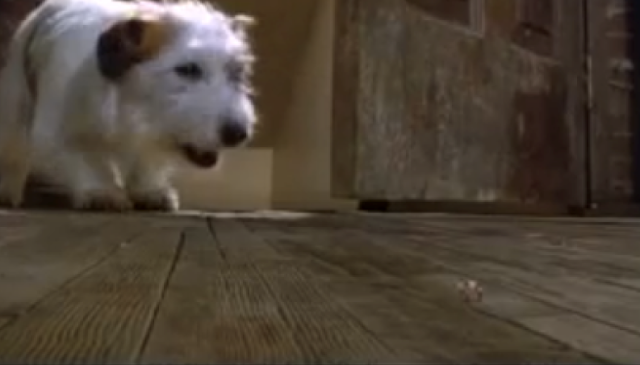

And every old tower has plenty of mice...


And roaches...


And even the bookworm infestation in the wizard's library poses deadly peril...


Of course, getting the wizard's attention won't be easy, and he won't watch where he is stepping... 


But, ultimately, if the PCs can get his attention, the NPC wizard will eventually be able to restore them to their normal size.

Some Twists

Here are a few more ideas for spicing up your "small world" adventure...

(1)  Maybe the NPC wizard did not shrink the PCs by accident, and instead has a sinister agenda.  Is he working for one of their enemies?  Does he want some rare and powerful magical items they are carrying?  Or is he just a greedy opportunist, who will happily extort the PCs before agreeing to reverse the potions' effects?

(2)  Were their other test subjects who suffered the same fate?  Maybe the NPC wizard's lab has been contaminated, and he has now unwittingly shrunk down several bands of adventurers.

(3) Maybe a jealous rival purposely contaminated the NPC wizard's lab.  Now, if the PCs don't act quickly, their one hope of returning to normal size will find himself dead.

(4)  Maybe the NPC wizard will shrink himself down too.  Now, the PCs have to figure out some way to manipulate a massive set of alchemical equipment to brew a cure.

Fun Ideas for Miniatures

This turned out to be a *great* game to run a few weeks before Halloween.  Stores are packed with rubber bugs, bats, spiders, and other goodies that you can use as miniatures for your game.

My favorite was a severed hand that worked perfectly for the Crawling Claw in the Wizard's tower...

 Hope you enjoy. And if you are looking for a "players' eye view" of this adventure, be sure to check out the session write-up my buddy T20s grunt posted over at Throwing Twenties here

- Balthazar

Thursday, September 3, 2015

Steal This: Character Creation Word Jumble

Staring a blank character sheet, a lot of players - myself included - can struggle to come up with a character concept.  


I have found this particularly true with  "new school" story games (like FATE) that allow players to play any character concept they can come up with.  Strangely enough, complete and unlimited freedom - without the traditional constraints of randomly rolled ability scores, or a limited menu of races and classes to choose from - can be overwhelming and even paralyzing for a lot of players.

One tool I've found surprisingly helpful for breaking the ice at character generation is the "Word Jumble" - basically, just a list of random words and concepts that fit the campaign you want to run.  Just pick 2 (or more) concepts, mash them together, sprinkle with your own ideas and creativity, and bam - you've got a character concept.

Below is an example of a "Word Jumble" I put together a couple years ago for a short campaign of Dresden Files I ran.  Some players, of course, needed no help at all coming up with a character concept.  But those who struggled said that this was very helpful for getting their creative juices flowing.

So, without further ado here's my Word Jumble for the Dresden Files campaign.  What do you think?  Helpful?  Would something like this be useful in other games?


The Dresden Files Character 
Word Jumble
(pick 2 or more, and mash them up)

Accountant ● Addicted ● Agent of ● Alchemist ● Army of ● Angel ●Anonymous ● Apprentice ● Aristocrat ● Assassin ● Assistant ● the Angel of Death ● Banshee ● Beauty ● Betrayer of ● Black Court ● Black Court Vampire ● Blue-Blooded ● Blue-Collar ● Bodyguard ● Boggle ● Born Sucker ● Born-Again ● Broke ● Brooding ● Bully ● Burglar ● Businessman ● By Night ● Captain ● Carries a Holy Sword ● Champion of God ● Changeling ● Charlatan ● Church Mouse ● Club Owner ● Clued-In ● Con Man ● Con-Artist ● Cop ● Corporate ● Crime Lord ● Crooked ● Cultist ● Curator ● Dabbler in ● Daughter of ● Dead ● Demon ● Demon-Summoning ● Denarian ● Detective ● Dilettante ● Djinni ● Doctor ● Drafted by ● Drug-Dealer ● Drug-Dealing ● Duelist ● Duergar ● Duergar ● Duke ● Ectomancer ● Einjeriar ● Elemental ● EMT ● Enemy of ● Enforcer ● Escaped ● Ex-Con ● Executioner of ● Exiled ● Faerie ● Father of ● FBI Agent ● Fetch ● Fixer ● Flesh-Eating ● Flunkie ● For Hire ● Forensic Examiner ● Former ● Former ● Frat-Boy ● Free Agent ● Freeholding Lord ● Friendly Neighborhood ● Gangster ● Gargoyle ● Gentleman ● Ghost ●  Ghost-Busting ● Ghoul ● Goblin ● Golden Boy ● Golem ● Goon ● Grad Student ● Guardian ● Guilt-Ridden ● Gun-Toting ● Hag ● Half Demon ● Half-Ogre ● Hatchet Man ● Haunted ● Haunted by Dark Knowledge ● Hedge Wizard ● Hellspawn ● Hexenwulf ● High Class ● Historian ● Hit Man ● Homeless ● Homunculus ● Hostage ● Hot-Headed ● Hydromancer ● Ice Cold ● Immortal ● In Hiding From ● In Training ● Indebted to ● Indiscrete Lover of ● Inexperienced ● Infected ● Infernal ● Information Broker ● Investigator ● Jaded ● Jann ● Journalist ● Kid ● King ● Kingpin ● Kitchen Witch ● Knight ● Knight of the Cross ● La Familia ● Lackey of ● Ladies Man ● Larcenous ● Last Champion of ● Last Disciple of ● Lawyer ● Lieutenant ● Little Brother ● Lovable ● Loyal ● Lycanthrope ● Made Man ● Mafia ● Martial Artist ● Mastermind ● Medieval Knight ● Medicine Man ● Medium ● Mentor to ● Mercenary ● Monster-Hunting ● Mother of ● Mummy ● Muscle for ● Mysterious ● Necromancer ● Nixie ● Noble ● Notorious ● Novice ● of Ferrovax the Dragon (“Mr. Ferro”) ● of House Malvora ● of House Skavis ● of Shadows ● of the Cross ● of the Dead ● of the Downbelow ● of the Major Crimes Unit ● of the Nevernever ● of the Roman Catholic Church ● of the Summer Court ● of the Summer Lady ● of the Summer Queen ● of the Venatori Umbrorum ●of the White Council ● of the Winter Court ● of the Winter Lady ● of the Winter Queen ● Ogre ● Old Money ● Old World ● on Campus ● Overly Credulous ● Paranormal Investigator ● Part Time Student ● Patriarch ● Pawn ● Pixie ● Politician ● Possessed by a Dead God ● Power Mad ● Preacher ● Precognitive ● Priest ● Prince ● Prison Guard ● Private Eye ● Professor ● Psychic ● Pyromancer ● Red Court ● Red Court Vampire ● Reformed ● Reluctant ● Renaissance Fair ● Renfield ● Reporter ● Representative of ● Retired ● Rookie ● Sadistic ● Satanist ● Scion of ● Scrupulous ● Secret Society ● Seen It All ● Senior ● Shaman ● Shape-Shifting ● Shop Teacher ● Sidekick ● Smooth-Talking ● Smuggler ● Son of ● Sorcerer ● Soul-Stealing ● Spell-Slinger ● Spy ● Squire ● Strong-Man ● Spirit ● Succubus ● Summoner ● Supernatural ● Superstitious ● Swordsman ● Sword-Toting ● Sylph ● Teenage ● the Spear of Longinus ● Tattooed ● Thief ● Thrall of ● Toadie of ● Trailer Park ● Trenchcoat Wearing ● Troll-Blooded ● Troubleshooter ● True Believer ● Two-Fisted ● Undead ● Underworld ● Unknowing ● Unwanted Ward ● Valkyrie  ● Vampire ● Vampire Hunter ● Vengeance Seeking ● Vigilante ● Viking ● Vindictive ● War God ● Warden of the White Council ● Warlock ● Warrior ● Wealthy ● Werebear ● Weremouse ● Werewolf ● Wheelman ● White Court ● White Court Vampire ● Voodoo ● Witch ● Wizard ● Working for ● Wyld Fae ● Young ● Zombie ●

Friday, August 21, 2015

Why You Should Be Running a Cloud Game (Part 3)

So, let's get back to our discussion of running "cloud" campaigns.  Confused because you missed the earlier installments?  You should probably click here.


Hits and Misses:  Some "Cloud" Campaigns I Have Run 

Before I start dispensing arguably questionable advice, let me give you a quick idea where I'm coming from.  My bona fides, if you will.  Over the past few years, I've run three separate "cloud" campaigns, for groups of ranging from a modest 13 players all the way to sprawling campaigns of 25 or more players.  Each time, I discovered some things that worked, some things that didn't, and a few things that just plain exploded in my face.  Here are my "takeaways" from each. 

My first "cloud" campaign was...

Skull Mountain - My "Cloud" Mega-Dungeon


 "Skull Mountain," was inspired by this awesome art from Callithlin.

Boy, this game was a beast. 

Goodman Games' delightful Dungeon Crawl Classics had recently come out.  And a lot of my favorite blogs, like Dungeon Fantastic, Dreams in the Lich House, The Mule Abides, and the Alexandrian were spilling lots of (electronic) ink on the subject of of the "mega-dungeon," a campaign set completely in a single, sprawling, multi-level monstrosity of a dungeon, which serves as the "tent-pole" or focus of the entire campaign.  So, I set out to design and run a "cloud" game in a mega-dungeon - following in the footsteps of the late, great Gary Gygax and his original Castle Greyhawk.


One of the handouts from the campaign:  A carving found early in the dungeon showing a cross-section of all the different levels.  Bonus points if you took Latin, and can read it!

The set-up was relatively simple.  A corrupt city modeled on Fritz Leiber's Lankhmar, built in the shadow of a terrifying, skull-faced mountain mega-dungeon that was once home to an evil sorcerer.  Each game night, the first eight players to sign up (via email) would team up, explore as much dungeon as they dared, and flee back to town before the game concluded. 

The dungeon was vast, with many different levels that were easy to access from the surface, lots of additional secret entrances and short-cuts that could quickly dump you into the deeper levels, and a few "sub-levels" and "mini-dungeons" (like the ruined castle sitting atop the Black Mountain) that presented their own special challenges. 


 Skull Mountain:  Level One Map (made from 4 pages of large graph paper taped together, scanned back before I went in and keyed all the rooms).

I ran Skull Mountain for about a year (real time) and about 15 or 16 games.  Now, let's talk about what worked, what didn't work, and what really, really didn't work.


Skull Mountain:  Things that Worked

Room for Just-About Everything - Skull Mountain, like all my "cloud" games, was essentially a pick-up game, not my main campaign.  So, while it was a very focused game (all about dungeon crawls in a single mega-dungeon), it also needed to be broad enough to hold my interest, with room to cram in interesting ideas from all the blogs and adventures I was reading.  The concept of a mega-dungeon built by a mad wizard works perfectly.  Find an interesting idea for a wandering encounter on The Dungeon Dozen?  Easy - just drop it right in.  For example, on just the first level of Skull Mountain, the players found:
  • "The Hungry Garden" - a cavern city of Myconids and other plant-monsters;
  • "The Extractor" - a high-tech machine from another world that extracted and stored the brains of those who tampered with it;
  • "The Midnight Maze" - a narrow, low-ceilinged, trap-filled maze wrapped in magical darkness, that the PCs had to explore by crawling and blindly feeling their way around;
  • "The Hall of Antiquities" - a "museum" of dangerous trophies from a dozen different worlds;
  • "The Cloning Chamber" - a dangerous device that could make (mostly) identical duplicates of whatever creature was placed in it;
  • "The Deathgate Puzzle" - a giant, ticking metal cube, covered in holes, that severs arms or releases monsters when you get the puzzle wrong....
...and lots and lots of other stuff.  No idea is "too weird" or "out of place" in a dangerous, plane-hopping wizard's dungeon.  So, after just a few games, gleeful players were running around with (barely controlled) pet golems, sci-fi disintegrator guns, mutations (like a second, talking face growing out of one PC's back), and all sorts of craziness.  Anything I cooked up, or read online, or dug up from some old adventure, could go right into the dungeon.

The "Escape the Dungeon" Rule - In any "cloud" game, one of the more difficult challenges is making sure that, before each session is over, the game reaches a suitable stopping point.  If Mike, Michaelle, and John are in the Skull Mountain game on Tuesday, but only John will make it to the next game, you obviously can't just stop cold in the middle of the dungeon.  So, I borrowed a simple rule I have seen used in a couple other games:  If the PCs didn't "escape the dungeon" and reach the surface by the allotted end-time, everyone had to roll on a ridiculous and deadly table I wrote up to determine their fate.  This worked surprisingly well.  All night long, the players would be nervously checking the time, and trying to gauge how far into the dungeon they could go and still make it out.  Only one group ever had to roll on the table, because they made sure they were  back in town before the session ended.

"The Wall of Shame" - I can't take any credit for this, because it just happened spontaneously.  During the very first game, as the PC body-count started to climb, players gleefully began tacking up the character sheets of their dead PCs up on the wall, often scrawling a witty pun about how the character met his or her end.  Great fun for both the players and myself, and it nicely reinforced the mood that this was an "old school" game where the occasional (or even frequent) character death was something to be expected and, indeed, reveled in.


Gold as XPs, and the Carousing Tables - I have always struggled with giving PCs something to do with all that gold they haul out of dungeons.  If you found a million dollars, why keep adventuring?  You're already wealthy enough to retire in kingly fashion?  Thus, the idea of using "carousing tables" to encourage PCs to fritter their treasure away has always struck me as an incredibly useful idea (see Rules & Roles here for an excellent overview on the history of "carousing" in D&D and the OSR).  


For Skull Mountain, I devised a series of carousing tables modeled upon various activities that dark fantasy adventurers often engaged in.  If your PC wanted to spend his or her time drinking and gambling, you rolled on "Carousing: Table A."  If you wanted to try your down-time luck cutting purses and burglarizing the local nobles, you rolled on "Thieving About Town: Table B."  If you wanted to pursue magical research, you rolled on "The Dark Arts: Table C."  And so on and so forth.  Every time a player showed up for a game, he or she picked one table and rolled.  Each table was loaded with various ways to lose all the gold and treasure they had found so far.  But for every 100 gp of gold lost or gambled away, they received a set number of experience points - so "losing" gold was really "winning" XPs.  With a really lucky roll, you might also increase one of your stats, or gain a henchman, or learn a new spell.  Of course, an unlucky roll could leave your character penniless, still wounded when the next adventure began, or badly needing treatment for a venereal disease. 

These tables worked fabulously, and the players never even considered "retirement," because treasure was just a stepping stone to a more powerful character. 

(As an aside, I'll be posting some of these carousing tables over the next few weeks.  Get your 1d30 handy and see how well you would fare.)

A Million Clues: Giving PCs a Reason to Talk - Here's another bit that worked far better than I expected.  Before the first PCs ever set foot in the dungeon, I took a few hours and put together a horde of partial maps, passages from adventurer's journals, and other little clues as to the major hazards of the dungeon, and then sprinkled these liberally around the opening areas.  But, to keep things interesting, only the player who actually "found" the map or handout could look at it during the game.  So, if Joe's Halfling discovered a partial map of the second level, Joe was free to consult and share that map while he was playing.  But if Joe's Halfling wasn't present at the next game, both he and his map were out of reach. 


A partial map one PC found of the first level.

Wondering who the god Vorn is?  You clearly need to buy this, the best city supplement ever produced for any RPG. 


Another partial map, this time of Level 2 (yes, I made a lot of maps).

Soon, there was a blizzard of handouts, clues, and maps flying around.  And each time a new group of PCs got together, they were eager to compare notes, hastily copy partial maps, and share news about what the others had found (and often run from) in the dungeon.  Thus, we had some great roleplaying in a game where that easily could have fallen to the wayside.

A Very Easy System - As I mentioned earlier, we used the Dungeon Crawl Classics RPG, which is relatively rules-light (except for the magic system), and similar enough to the core of D&D 3.5 that my players easily picked it up.  Even better, you can whip up an entire batch of 0-level starting characters in just a few minutes - perfect for a game where new players might show up unexpectedly, and established characters tended to die with some regularity.


Skull Mountain:  A Couple Big Mistakes

Skull Mountain was a blast, but as a "cloud" game, it suffered from two pretty big flaws... 

Out-of-Control Prep Time - First, as anyone who has tried to run a mega-dungeon campaign knows, they are incredible time sinks.  Just getting the dungeon "ready for play" took weeks of work.  Even more problematic, I often found myself spending hours on particularly clever puzzles, traps, and encounters, only to stare on in horror as group after group walked into the Room of the Perilous Whatzit, decided that damned thing looked waaaaaaaay to dangerous to mess with, and decided to take the long way around.  This was great for player freedom and choice, but rough on the poor, overworked DM.

A Too-Narrow Focus - The other big problem with Skull Mountain was the limited focus on dungeon-crawls.  Sure, lots of us love a good crawl.  But certainly not everyone.  The players who tend to enjoy roleplaying and politics more quickly began pushing to expand the game into something it was never meant to be (e.g., adventuring in the city, or just plain hanging out in the tavern).

Were these "fatal" flaws?  Not really.  Skull Mountain had decent run, and every game inevitably comes to an end.  But when I wrapped it up, I knew that my next "cloud" campaign would need a little broader focus, and that I would have to find some way to reign in the out-of-control prep time.  But I'll write more about that in Part Four, coming soon.

Continue to Part Four. 


Tuesday, August 11, 2015

Campaign Sprawl

Fair warning:  I definitely have some sort of mild to moderate OCD, or other mental issue.  So, take anything I may write on this blog with that in mind.  Want an example?

I'm about 15 games into a Vampire the Masquerade (20th anniversary edition, or "V20") campaign.  And one of the conceits of the campaign is that we play 5-6 games in an "era," and then pick up with the characters again several decades later.  The great thing about this is that the characters really do "feel" old.  They players managed to seize control of the city back in 1863, but now, more than a century later, they still hold bitter grudges against various NPCs over things that occurred way back in 1904 and earlier.

But back to my warning.  So, at the start of our campaign, the vampires of the city looked like this...


BTW, I love, love, love making posters summarizing campaign info, that you can tack up on the wall and reference during the game.  Not only is it very helpful for the players (they can quickly recall names and other information with just a glance), but it almost inevitably leads to the players sitting around the game table, hours after the game, poring over the posters like Napoleon studying maps of battlefield topography.

But I digress again.  Back to that warning...

So, a few years later (the next era - 1904), the campaign map has gotten more complicated.  We've got a bigger, more populous, and more complicated web of vampires in the city:


I've also figured out that, gosh, the mortals are important too, so the important ones in the city get their own poster:


And don't forget those vampire diplomats that visited St. Louis (our home city) during the 1904 World's Fair:


Things keep progressing from era to era, with the game (and the ridiculous posters) growing more and more complex.  Until finally, last night, we have this:


This is our "basic" poster for 1978.  And, yes, that's every vampire in the city (or at least the vampires the players know about), along with their "registered" (with the Prince) ghouls, as of 1978, our current game era.

Have I crossed the line from "helpful player aid" to "crazy guy scribbling all over the walls of his cell"?  Only time will tell...  (But my wife is sitting behind me making fun of me already).

Sunday, August 9, 2015

You Should Be Doing This: Paper Miniatures

It's Sunday, so let's take a diversion.  Let's talk about miniatures.

Okay, I'm going to put to the side the basic question of whether or not you should use minis in your games.  I myself go back and forth.  I've run (and played) lots of great games where miniatures were used.  I've also enjoyed games, D&D or otherwise, without minis.  And I've certainly seen a lot of games where using miniatures became a pain in the ass, distracting, or just otherwise unnecessary or inappropriate. 

So, I recently got back from Gen Con 2015, and saw the full spectrum of miniatures usage.  One the one end, I tend to go a little crazy on con games, bringing all sorts of elaborate miniatures, re-purposed children's toys, pre-drawn battlemaps, and whatever.  But I also played in a game where we used "miniatures," but they basically consisted of a couple painted meeples from an old board game, a bottle cap or two, and whatever other trash was left sitting around from the game before us....
 Q:  "Uh, is that another enemy wizard?"  
GM:  "Oh, no, I just forgot to put the top back on my drink."
Now, as a tactical "aid," this left a lot to be desired, and wound up causing a lot of confusion at the table.  To be honest, I would have preferred (and found it less confusing and more immersive) if the GM had not used miniatures at all.  I'm really not a game-prep snob.  Okay, okay, I totally am.  But if you have got any kind of lead time, and access to basic 2015 computer technology, you can do a lot better with  10 minutes work.  Here's how. 

All you need is:
  • A color printer;
  • A few pages of photo or cardstock paper;
  • Microsoft Word or an equivalent; and
  • Google image search.
Start with this template - which I just cribbed from the old 1984 Marvel FASERIP rpg.


Now, I don't know crap about computers, photo editing software, or anything.  I just figured this out on my own, so apologies to you techies for using "cave-man speak."

First, Cut and paste that  sucker (the template above) into a Word document a bunch of times.

Next, run a Google image search for whatever thing you are using in your game.  So, if I want to use the Melter, from Marvel comics, in my game, I do a search and find this image...


Even basic word processing and editing programs, like Microsoft Word or Powerpoint, now have a cool feature called "Remove Background," which will let you to trim a picture down and make it more miniature or presentation friendly, after you have copied it into your document.

So, yeah, cut and paste your image into your word document.  Initially, it will "push" your templates down.  But don't worry, that's easy to fix.  Just right click the image, and then go either to "Size and Position" or "Wrap Text."  You want to reset the image so that it appears "In Front of Text."  That will basically allow you to pull the image over the template.  Like this...


Super easy, right?   Do that a bunch, and you've suddenly got tons and tons of paper minis, ready to go.  It *does* take a little time to cut our and paste together, or you can just pay the kiddos into doing it for you (my preferred method - and my 6-year old daughter is super awesome at it!).

 Toy police cars, and my daughter's hand, not included...
And, voila, you've got some paper minis that are pretty durable, tailored to your game, and lots of fun to look at and play with.  Also, bonus, they are nice and light for carrying around at a convention.

Next up, probably more on Cloud games, unless I get distracted again...

Saturday, August 8, 2015

Why You Should Be Running a "Cloud" Game (Part 2)

So, practically speaking, how do you get your "cloud" game off the ground?

"This is sweet!  We haven't all hung out together since college!" 

The Really Mundane Stuff

So, here's some basic, nuts-and-bolts stuff you need to get your cloud game off the ground:


(1) A big list of potential players, more the better.  My current roster is about 25.  Obviously, they should  have an interest in RPGs.  But, unlike your "regular Thursday night" crew, they don't have to be "hardcore" folks.  The old friend with 5 kids who loves to game, but can't find a regular group because he is a nightmare to schedule.  The newbie from work who is interested, but reluctant to commit to playing once a week for the next 12 to 14 months of the campaign.  The "nerd-friendly" or "nerd-curious" boyfriends and girlfriends of your regular players.  Your double from Shelbyville, who also runs games across town.  Anyone with an interest in RPGs is a candidate, but especially those who aren't in a regular group because their availability is limited.

(2) Some way of mass communication, like a big old email list.  This is important not just for scheduling, but for post-game action reports (written by players) to keep player interest high.

(3) And, of course, a place to play.

A Couple Thoughts on Pitching Your Cloud Game


In pitching your game to potential players, the most important point to stress is that this is a zero commitment proposition.  Players can come and go as they please, and are not expected (and likely not able) to play every game.  In my experience, this is a huge draw for casual gamers, as well as gamers with "grown-up" lives and responsibilities. 

Also, don't neglect the "social mixer" aspect of a cloud game.  Gamers tend to know lots of other gamers, but regularly play with only a few (i.e., their regular group).  A cloud game is an opportunity to play casually, with new and interesting people.

Finally, consider including an element of competition in your cloud game pitch.  Ars Ludi has an excellent discussion (here) about how a "gold rush" atmosphere can increase player interest.  After all, if another group of players gets to the Demon Lich's Tomb first, then they get the fabulous treasure within, not you.

(You jerks beat me to the lich's treasure room?!?!  Argh!!!)
 

So, What Do I Run?  Picking a Game System


When picking a game system, keep the following in mind:  

Definitely Pick a System that is Simple and Easy to Learn (or Universally Known) - Keep in mind that, while some players will be showing up often, others might go a few months between games.  The later will have no patience and no desire to learn a new, complicated game system (and, even if they manage to learn it, will likely forget it by the time they show up again).  So the RPG you pick must either be universally known, even to the most casual gamer (e.g., like D&D 3.5 back in its heyday), or simple enough for anyone to pick up at the table with minimal effort. 

Character Creation Must Be Easy, and Take 10 Minutes or Less - Likewise, making a character must be easy, and I mean EASY.  Ideally, the system you are using will allow players to whip out a character in less than 10 minutes.  

Consider Picking a System that is Just a Little Bit Different - At the same time, some of the appeal of a cloud game is the opportunity to play something different than everyone's "normal" game.  If all your potential players are already playing Pathfinder, the market for a cloud game using that system might already be tapped out.  

Watch Out for "Controversial" Games - For better or worse, certain games tend to elicit stark, absolute, sometimes overblown reactions (maybe abject love, maybe bile-filled hate) from gamers.  For example, in my own circle of gamers, there is simply no middle ground on "aspect" games (FATE, and its derivatives such as Dresden Files), or other "new school" games that grant the players some degree of narrative control.  Some folks love these kinds of games, and think they are the best thing since sliced bread.  Others barely consider these "games" at all.  Of course, on an issue of pure taste, there is no right or wrong.  But in a cloud game, you are trying to cast the widest net possible for players, and you need a lot more than is necessary for a regular "party" game.  So, if you know that a particular game or type of game is going to turn off a large number of potential players, consider picking something closer to the middle of the road.

A Few Game Systems that Have Worked for Me - Here are a few games I've enjoyed some good success with in my own cloud games...

Marvel FASERIP - One of my favorites for a cloud game.  Simple, quick rules.  Random character generation.  A basic premise (superheroes) that is perfectly suited for episodic play.  And best of all, the old books are available in PDF free online (at www.classicmarvelforever.com). 

"I  have Incredible (40) Strength and Amazing (50) Reflexes?  Sweet!"

Dungeon Crawl Classics - Another fun one, combining the familiarity of D&D 3.5 with stripped down mechanics and quick, random character generation.

D&D 5e - What I'm using for my current game.  Easy, simple mechanics that are pretty much intuitive for anyone who has played D&D over the last 30 years.

Next up, designing a "campaign" for a cloud game, and some awful, disastrous, hair-pulling mistakes I have made when running such games. 

Continue to Part Three.

Friday, August 7, 2015

Why You Should Be Running a "Cloud" Game (Part 1)

So, way back in the misty dawn of time (the 1970s), people gamed a lot differently than today.  D&D was a brand-new phenomenon, and the notion of a "regular" or "weekly" group, while certainly not unheard of, wasn't the default.  Instead, there was a "cloud" - or really a "crowd" - of players and GMs, all crashing together and breaking apart in a maelstrom of players, GMs, campaigns, and campaign worlds.

The Greyhawk Grognard has an excellent discussion of the entire phenomenon here, and this type of game style was popularized by Ars Ludi in his delightful West Marches game and posts.  ConstantCon is another modern incarnation of this style.

So, what the heck is a "cloud" game?   


"Heck yeah, let's *all* play some D&D!"

At its core, a "cloud" game is just like your regular, Thursday night game, with a few key differences:

1.  There Is No Party.  Instead, you have a rotating cast of players and characters, which changes from game to game, week to week.  There is no requirement - or expectation - that a particular player or group will show up for any particular game.  One week, Bob, John, and Sharon might show up for a game.  The next week, Stacy, Mike, Joe, and Crystal.  The players are whoever shows up on a particular night.  In my own cloud games, I've had upwards of 25+ players, all rotating in and out. 

2.  Episodic by Design.  Because you have no set "cast" of players or PCs, each game must be, in some sense, self-contained.  You can't just quit in the middle of a dungeon and expect the same players to show up the following week.  This can be somewhat daunting to accomplish, but I'll give you a few tips below on how you can pretty consistently steer your herd of players into doing this for you.

3.  One World, but Many Stories.  Maybe not required, but definitely preferred.  All of the players' characters are existing in the same world.  So, when Jorgun the Fat (Barbarian-1) burns down the Temple of Blaargh on Friday night, the group that shows up next week will hear about that, and the world will be changed.  This creates some great roleplaying opportunities.  Unlike a regular group (where everyone at the table is pretty much operating from identical knowledge about what is going on in the campaign) PCs in a "cloud" game have different experiences, and things to talk about.  Jorgun and his buddy Marsh might have adventured together back in April, and not play together again on the same night until July.  In the interim, they have had different adventures, explored different dungeons, and learned different things about the campaign world.  They really do have different stories, and different accomplishments to brag (or lie) about.

Next up, in Part 2, I'll walk through how to set up a cloud game, and some pitfalls I've (slowly) learned to avoid in running my own cloud games.


(More) Why You Should Be Using Powerpoints and Pictures in Your Games...

Want to run a game of immortal intrigue, with a large cast of scheming NPCs?
 

A "cast of characters" map - with memorable pictures - really helps.  This is from the "St. Louis by Night" Vampire (V20) game I'm currently running. 

Sure, you can (and should) describe the creepy, yet somehow honorable, Eastern European Gangrel Wolfgang Von Rorza.  But if you throw up a slide showing this...


...something magical happens.  I just look at that picture, and instantly know how I want to role play him.  I know how he talks.  I know how he looks at you.  And, most importantly, its memorable. 

The players - who have been deluged with literally hundreds of different NPCs over the campaign - know exactly who Wolfgang is.  We, as human beings, are hard-wired to remember faces.  Because they matter.  Why not take advantage of that?

Another crazy Malkavian?  Easy, here's Felix...


One more?  Sure, meet Bernice and (in the game at least) her incredibly life-like doll...


I can (and should) describe how the nighttime road in 1929 St. Louis looks to my players.  But throwing up a picture from that time really sets the mood in an almost indescribable way.


Google image search is an incredibly powerful tool for GMs.  And with just an old laptop and a spare computer monitor (relatively cheap these days), adding visuals to your game, and displaying them to your players, is super easy.

There are also some other incredible tools available, the kind of stuff I could only dream about when I was back in college, making handouts by drawing pictures and soaking them in tea to give them that "antique" look. 

My current favorite is a nifty set of PDFs called Mutable Deceptions, Volume I:  Jazz Age Newspapers, from Cthulhu Reborn (cthulhureborn.wordpress.com).   Go buy this right now.  Basically, an easy-to-use set of PDFs that allow you to create newspaper handouts in just minutes.  Here's one I put together for my V20 game, that took all of 5 minutes, including the time it took to find a picture of an old building burning down.


Visuals are also great for "court" or "meetings," where a lot of different NPCs are present.  Rather than force the players to keep asking "who is here?" over and over, you can just throw together a quick slide that conveys all that information at a glance.  Going to a meeting of the vampire primogen?  Who is there to talk to?  Easy, just look at the screen...


I also love visuals for the "gross out" effect.  Especially in a horror game.  My players recently began negotiating with a very sketchy Tzimisce "fleshcrafter."  And, as luck would have it, they decided to visit his house.  Well, if you've played the old Vampire: Bloodlines videogame, you know that has to lead to awfulness.  But the reaction to this was priceless...


Bonus points if you recognize the movie this is from.  In my powerpoint, it is actually an animated gif where the people writhe in unspeakable agony.  But, hey, I'm not very tech-savvy.