Showing posts with label Neverwinter. Show all posts

Friday, February 17, 2017

5e Forgotten Realms Clerics: Bane & Beshaba

More domains for your 5e Forgotten Realms clerics - this time, my beloved (but straightforward) Bane and the malevolent misfortune that is  Beshaba...

BANE, the Black Lord, the Black Hand, the Lord of Darkness, the Dark One.

·     Portfolio: Strife, Hatred, Tyranny.
·     Clergy Titles – Generally, “Dread Brother/Sister” or Dreadmaster.”  Formal Ranks:  Wretched Slave (before 1st level), Watchful Brother/Sister*, Deadly Adept, Trusted Servant, Willing Whip, Hooded Menace, Black Fang, Striking Hand, Vigilant Talon, Masked Death, Dark Doom, Higher Doom, Deep Mystery, with higher ranks including Imperceptor, Dark Imperceptor, Grand Bloodletter, High Inquisitor, and High Imperceptor.
·     Clerics of Bane – Per standard cleric with the Tyranny Domain, per the following:
·    Bonus Proficiencies – At 1st level, you gain proficiency in heavy armor, as well as proficiency in the following martial weapons:  Flail, Morningstar, Warhammer, and Whip.  You also gain proficiency in the Intimidation and Persuasion skills.
·    Channel Divinity:  Command Undead – Dreadmasters can turn or command undead.  Beginning at 2nd level, as an action, you may expend one use of Channel Divinity and force all undead within 30’ that you can see to make a Charisma saving throw vs. your spell save DC or become friendly and obey commands.  Intelligent undead (8 or higher) receive Advantage on the saving throw and, if it has Intelligence 12 or higher, it receives a new save after each hour of control.  If more than one cleric is vying for control over the same undead, a contested Spell Attack roll (Wisdom modifier + Proficiency bonus) determines who maintains or gains control.  The maximum number of undead you may have under your command at any time is 3 x your level.
·    Channel Divinity:  Domination – Beginning at 2nd level, as a free action, you may expend one use of your Channel Divinity to grant a single foe Disadvantage on a Wisdom saving throw against one of your spells.   This penalty does not apply to successive attempts to save and end the spell effect.
·    Channel Divinity: Aura of Fear – Beginning at 6th level, you can use your Channel Divinity to force all creatures within 30’ of you to make a Wisdom save or become frightened of you.  Alternatively, you may target a single creature within 30’ of you, in which case the target makes it saving throw with Disadvantage.  Either way, targets may repeat their save (without Disadvantage) at the end of each of their turns until successful. 
·    Divine Strike – Beginning at 8th level, once per turn when you strike a foe with a weapon attack, you can cause the attack to deal an extra 1d8 damage of the same type dealt by the weapon.  When you reach 14th level, the extra damage increases to 2d8.
·    Iron Will – Beginning at 17th level, you gain Advantage on all Wisdom saving throws.

Tyranny Domain Spells

1st Level:  Command, Wrathful Smite

3rd Level:  Hold Person, Spiritual Weapon

5th Level:  Bestow Curse, Fear

7th Level:  Banishment, Freedom of Movement

9th Level:  Black Hand (treat as Bigby's Hand), Hold Monster


BESHABA, the Maid of Misfortune, Black Bess, Lady Doom, the Maid of Misrule.

·       Portfolio: Bad Luck, Random Mischief, Misfortune, Accidents.
·       Clergy Titles – Generally, “Doommaster” or “Brother/Sister Misfortune.”  Formal Ranks:  Bewildered Brother/Sister*, Unfortunate, Finger of Fear, Hand of Strife, Higher Hand of Strife, Hand of Gloom, Higher Hand of Gloom, Hand of Horror, Higher Hand of Horror, Hand of Despair, Higher Hand of Despair, Mistress/Master of Dread, and Nails of the Lady. 
·       Clerics of Beshaba – Per standard cleric with the Misfortune Domain, per below: 
·       Weapon & Armor Proficiencies – Light and Medium Armor, Shields, Simple Weapons.
·       Bonus Proficiencies – At 1st Level you gain Proficiency in Gaming Sets.
·       Accustomed to Danger – At 1st level you gain Proficiency in Dexterity Saving Throws.
·       Additional Cantrip Options – The cantrips Acid Splash, Blade Ward, Minor Illusion, Poison Spray, Shocking Grasp, and True Strike are treated as cleric cantrips for you – you may select one or more of them in the place of your normal cantrips at 1st level.
·       Misplaced Fumbles – Whenever you roll a natural 1 on an attack or save, you may reroll.  Once in the next day, the DM will impose your 1 on an ally or fellow PC in the place of their roll.
·       Channel Divinity:  Bane of Beshaba – Beginning at 2nd Level, you can use your Channel Divinity as a reaction to force an enemy within 60’ to reroll any single 1d20 roll (attack, save, etc.), and take the lower roll.  This decision must be made immediately, before the DM applies the result of the roll.
·       Channel Divinity: Misfortune – Beginning at 6th level, as a bonus action, you can expend one use of your Channel Divinity as a reaction to impose Disadvantage on a single enemy on all 1d20 rolls (attacks, saves, skill and ability checks) until the start of your next turn; enemies targeting the recipient gain Advantage on their attacks until your next turn.
·       Beshaba’s Favor – At 8th level, any enemy rolling a critical hit or natural 20 against you must reroll the attack.  A second 20 is treated as a natural 1.
·       Disasters Abound – At 17th level, as a bonus action you may call upon Beshaba to curse one enemy within 60’.  For one round, until the start of the next turn, all attacks by the enemy are treated as natural 1’s, all spells and powers used by the enemy inexplicably fail, and the enemy automatically fails all saving throws, skill, and ability checks (again treated as natural 1’s).  Anyone attacking the enemy during this round gains Advantage, and any hits are treated as critical hits.  You cannot use this power again until after you take a long rest.

Misfortune Domain Spells:

1st Level:   Grease, Dissonant Whispers

3rd Level:  Crown of Madness, Invisibility

5th Level:  Bestow Curse, Slow

7th Level:  Confusion, Dimension Door

9th Level:  Geas, Modify Memory

5e Forgotten Realms Clerics: Auril & Azuth

One of my few criticisms of D&D 5e is how little variety you get with clerics. 

Second edition introduced the idea of "specialty priests," and fabulous supplements (like Faiths & Avatars) offered scores of very interesting cleric variations, each with powers and spells tailored to their specific god.  Third edition employed "domains" to create a similar effect. 


The 5e Player's Handbook likewise uses a "domain" mechanic.  And I think it works very well.  But the PHB only includes six domains (knowledge, life, light, trickery, tempest, and war).

So, let's fix that with some new domains that I put together for use in my home game. 
 
WARNING:  I tend not to give much care to "game balance."  These are not, and not intended to be, "balanced" against one another.  And they are not direct translations of the powers described in the old Faiths & Avatars book, although that is certainly a source of inspiration for these. 


AURIL, the Frostmaiden, the Icedawn, the Cold Goddess, Lady Frostkiss.

·       Portfolio: Cold, Winter.
·       Clergy Titles – Generally, “Hand of Auril,” “Icepriest,” or “Icepriestess.”  Formal Ranks:  Postulant, Icewind*, Storm Sister/Brother, Frosttouch, Lady/Lord Cold, Lady/Lord Winter, High Hand of Ice.
·       Clerics of Auril – Per standard cleric with the Winter Domain, per below: 
·       Armor & Weapon Proficiencies – Light and Medium Armors, Shields, Simple Weapons, all Martial Axes.
·       Bonus Proficiencies – At first level, you gain proficiency in the Survival skill and with Constitution saving throws.
·       Cold Resistance – At first level, you gain resistance to all cold damage.  At 6th level, you gain immunity to all cold damage.
·       Frosty Cantrips – One of your initial cantrips learned must be Ray of Frost.  You gain Advantage when attacking with Ray of Frost, and deal +1d8 cold damage when using this cantrip.
·       Frozen Magicks – Any spell cast by you that would normally deal acid, fire, lightning, necrotic, poison, radiant, or thunder damage (but not bludgeoning, slashing, or piercing) instead deals cold damage.  The spell otherwise functions the same.  For example, Sacred Flame becomes “Sacred Frost,” and deals 1d8 cold damage on a failed save.
·       Channel Divinity:  Aura of Cold – Beginning at 2nd level, as a bonus action, you may expend one use of your Channel Divinity to radiate a freezing aura for 1 minute.  Any creature that starts its turn within 5’ of you takes 3d6 cold damage (Constitution save for half).  Creatures you are grappling have Disadvantage on their save.  At 8th level, this damage increases to 5d6.
·       Channel Divinity:  Command Undead – You can turn or command undead.  Beginning at 2nd level, as an action, you may expend one use of Channel Divinity and force all undead within 30’ that you can see to make a Charisma saving throw vs. your spell save DC or become friendly and obey commands.  Intelligent undead (8 or higher) receive Advantage on the saving throw and, if it has Intelligence 12 or higher, it receives a new save after each hour of control.  If more than one cleric is vying for control over the same undead, a contested Spell Attack roll (Wisdom modifier + Proficiency bonus) determines who maintains or gains control.  The maximum number of undead you may have under your command at any time is 2 x your level.
·       Channel Divinity: Ice Axe – Beginning at 6th level, as a bonus action, you may expend one use of your Channel Divinity to create an axe (hand axe, battle axe, or greataxe) of unholy ice.  This functions as a +2 magic weapon, and deals +2d6 cold damage in addition to the normal weapon damage.  It lasts for 10 minutes.
·       Frozen in Ice – Beginning at 8th level, when you damage a foe with cold magic, you may expend one use of your Channel Divinity as a bonus action to coat one target damaged in ice.  The target is restrained (covered in a sheen of thick ice).  It can attempt a Strength saving throw against your spell DC at the end of each of its turns to shatter the ice and end the effect.
·       Frozen Juggernaut – At 17th level, once per long rest, as an action, you may summon an Ice Elemental (treat as Earth Elemental with immunity to cold and no Earth Glide power).

Winter Domain Spells:
 
1st Level:  Ice (treat as Grease spell), Icy Blast (below).

3rd Level:  Cloud of Ice Daggers (treast as Cloud of Daggers), Magic Weapon.

5th Level:  Icy Touch (treat as Vampiric Touch), Sleet Storm
 
7th Level:  Ice Storm, Iceskin (treat as Stoneskin)
 
9th Level:  Cone of Cold, Wall of Ice.
 
Icy Blast – Level 1 Evocation, Casting Time: 1 action, Range 90’, Components (V,S,M) (piece of ice or snow lion's tooth). A flurry of ice and snow erupts from a point you choose in range.  Each creature  in a 5 foot radius must make a Dexterity saving throw.  A creature takes 3d6 cold damage on a failed save, or half as much damage on a successful one.  At higher levels:  When you cast this using a spell slot of 2nd level or higher, the damage increases by 1d6 for each slot level above 1st.


AZUTH, the High One, Patron of Wizards, the Lord of Spells, the Hand of Mystra, Lord of Spellcraft.

·       Portfolio: Wizards, Mages, Spellcasters.
·       Clergy Titles – Generally, “Magistrati.” 
·       Clerics of Azuth – Per standard cleric with the Wizardry Domain, per below: 
·       Armor & Weapon Proficiencies – You are not proficient in any armor or shields, and only the weapons on the Wizard class list.
·       Arcane Initiate – At first level, you gain proficiency in the Arcana skill.  You may also opt to select your starting cantrips from the wizard spell list, instead of the cleric list.
·       Intellect Over Wisdom – Clerics of Azuth use Intelligence, rather than Wisdom, for their spell attacks and saving throw DCs.  They are also proficient in Intelligence saving throws.
·       Arcane Spell Preparation – Clerics of Azuth get Domain spells for the Wizardry Domain, in the table below.  Additionally, clerics of Azuth with access to an arcane spellbook may prepare one or more spells from that book, instead of from the cleric spell list.  Arcane spells prepared in this way use the cleric’s Intelligence modifier and full proficiency bonus.  You do not automatically gain a spellbook or learn any arcane spells when you advance in level – you must acquire them in the course of your adventures.
·       Arcane Item Use – You may use any magic item that wizards can use.
·       Channel Divinity: Arcane Power – Beginning at 2nd level, as an action, you may expend one use of Channel Divinity as a bonus action to recover a single spell slot of any level you can cast.
·       Channel Divinity: Swift Magics – Beginning at 6th level, as a free action, you can expend one use of your Channel Divinity to allow you to cast any spell with the duration of 1 action as a bonus action (allowing you to cast two spells in a turn).
·       Potent Cantrips – Starting at 8th level, you add your Intelligence modifier to the damage you deal with any cantrip.
·       Arcane Mastery – At 17th level, you gain Advantage on all saving throws against magic or magical effects.

Wizardry Domain Spells:
 
1st Level:  Identify, Mage Armor

3rd Level:  Nystul's Magic Aura, See Invisibility

5th Level:  Counterspell, Dispel Magic
 
7th Level:  Arcane Eye, Banishment
 
9th Level:  Legend Lore, Planar Binding


Thursday, October 8, 2015

Steal This: Honey, I Shrunk the PCs

Did your players just ditch tonight's adventure hook?  Need something to throw at them quick? Well, you're in luck!   

I call this one, "Honey, I Shrunk the PCs."


I inflicted this lil' bit of awfulness on the players last week in my Neverwinter Nights "cloud" game, and it was quite a hit. 

The Setup...

An NPC wizard (preferably someone who has sold the PCs potions or other magical goodies in the past) needs adventurers to test out some new potion recipes.  He'll pay good money - either in potions, magic, or coin, whatever the PCs prefer - if they will come to his tower, drink a few potions, and see what the results are.

In my game, the PCs responded to this "want ad" from their friendly, neighborhood potion dealer...


Once the PCs take the bait, the wizard will walk them a bit away from his tower, and plunk down a chest full of random potions.  To earn their pay, all they have to do is drink 1 potion and answer a few questions.  

For my own game, I used this table to randomly determine the effect of drinking a potion. 

Random Potion Effects - Roll 1d20

1-6, Potion is a "dud."  No effect at all, beyond a bit of mild stomach discomfort and some gas.

7-8, Bioluminescence.  The drinker's body glows with an unhealthy orange light.  Not painful, but grants Disadvantage (in D&D 5e) or a penalty of the GM's choice (in other systems) on all Stealth checks.  The effects last 1 day.

9, Speak with Animals.  The drinker naturally understands and can communicate with any natural animal or insect.  This doesn't make the animals or insects any smarter, but crude communication and rudimentary bargaining is possible.  The effects last 1 day.

10, Philter of Hair Regrowth.  If the drinker suffers from baldness, this is permanently cured.  Either way, all of the drinker's hair immediately grows 2d6 inches, and another 2d6 inches each hour.  The cure for baldness is permanent, the other effects fade after 1 day. 

11, Philter of the Rake. The drinker becomes incredibly handsome or beautiful and nigh-irresistible in the romance department. Gain Advantage on all social rolls with anyone attracted to the drinker's sex.  The effects last 1 day.

12, Draught of Absolute Honesty.  No apparent effect, but the drinker becomes unable to tell lies, or say anything but the absolute, complete truth.  Attempts to lie or mislead in any way wrack the drinker with choking fits and agonizing pain (1d6 hp per attempt).  The effects last 1 day.

13, Potion of Rhyming.  The drinker becomes unable to speak except in rhyming couplets.  If the drinker affirmatively tries to speak without rhyming (such as trying to cast a spell), he or she takes 1d6 hp and the attempt fails.

14, Potion of Premature Aging.  The drinker suddenly advances to incredible old age, and gains Disadvantage on all physical ability or skill checks (including attacks).  The effects last 1 day.

15-16, Treant's Draught.  The drinker's skin becomes as tough as bark, and he or she gains an inherent +2 to AC. The effects last 1 day.

17-18, Potion of Partial Invisibility.  The drinker's body (but not his or her equipment) fades into invisibility.  No game effect (but may weird some people out and impose penalties on social checks).  If the character sheds all clothing and equipment, he or she gains the benefits of the Improved Invisibility spell.  The effects last 1 day.

19-20, Trollblood Potion.  The drinker suddenly begins regenerating, as per a Troll.  Even death will not stop the drinker from regenerating and returning to life.  The effects last 1 day.

It's a Small World After All

After the PCs finish drinking their potions, the NPC wizard happily pays them their reward and takes his leave - walking back to his tower nearby. 

A few minutes after that, all of the PCs who drank a potion begin to feel a bit light-headed.  And, one by one, they begin "vanishing" in a flash of light, as each one shrinks down to 1 inch tall - about the same size as a D&D mini...

"Is it just me, or did the grass get really tall all of the sudden..."

Now, if the PCs want to return to their normal size, they need to trek back to the NPC Wizard's tower, get his attention, and persuade him to reverse the effect.

GM NOTE ON SMART OR PARANOID PLAYERS:  You should really push all of the PCs to sample the potions.  Feel free to keep upping the rewards until it becomes too tempting to resist.  Or, if a player is particularly stubborn, have the NPC wizard elect him to help clean up the vials or hold some of the potions - and then just accidentally slop a little potion on him that way.  Of course, very paranoid or clever PCs may be able to avoid this adventure entirely - but that's the breaks. Give him a Spot check to find his "vanished" fellows and, if he fails it, I guess he spends  this game back at the tavern wondering where they went...

Miniature Terrors!

The PCs will quickly discover that their "tiny adventure" is no picnic.  Normal animals and bugs will find the PCs to be a delectable and "bite sized" feast! 

Trekking through the woods, they may face hungry frogs...


A pixie that is eager to get a little payback on the stupid humans who normally torment her (she's several times their size, and excited to be the big bully for once...)


A stray cat is the size of a dragon, but not as nice...


Hordes of pigeons or hungry seagulls can peck the PCs to death...


And, once the PCs manage to get back into the NPC wizard's tower, more danger awaits!  Of course there are plenty of spiders in the tower, eager for a meal...


The PCs may "need a hand" with the NPC Wizard's Crawling Claw...


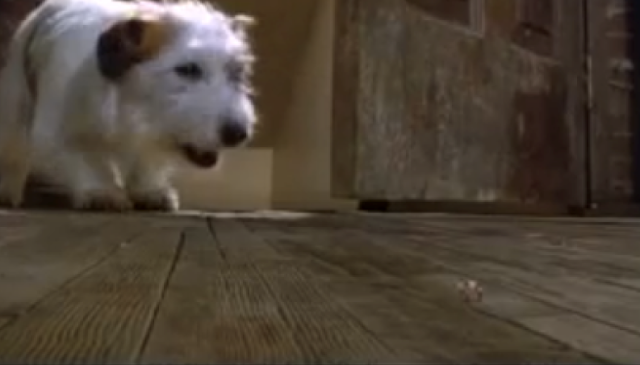
The wizard's dog seemed cute and friendly before, but not so much now...


And every old tower has plenty of mice...


And roaches...


And even the bookworm infestation in the wizard's library poses deadly peril...


Of course, getting the wizard's attention won't be easy, and he won't watch where he is stepping... 


But, ultimately, if the PCs can get his attention, the NPC wizard will eventually be able to restore them to their normal size.

Some Twists

Here are a few more ideas for spicing up your "small world" adventure...

(1)  Maybe the NPC wizard did not shrink the PCs by accident, and instead has a sinister agenda.  Is he working for one of their enemies?  Does he want some rare and powerful magical items they are carrying?  Or is he just a greedy opportunist, who will happily extort the PCs before agreeing to reverse the potions' effects?

(2)  Were their other test subjects who suffered the same fate?  Maybe the NPC wizard's lab has been contaminated, and he has now unwittingly shrunk down several bands of adventurers.

(3) Maybe a jealous rival purposely contaminated the NPC wizard's lab.  Now, if the PCs don't act quickly, their one hope of returning to normal size will find himself dead.

(4)  Maybe the NPC wizard will shrink himself down too.  Now, the PCs have to figure out some way to manipulate a massive set of alchemical equipment to brew a cure.

Fun Ideas for Miniatures

This turned out to be a *great* game to run a few weeks before Halloween.  Stores are packed with rubber bugs, bats, spiders, and other goodies that you can use as miniatures for your game.

My favorite was a severed hand that worked perfectly for the Crawling Claw in the Wizard's tower...

 Hope you enjoy. And if you are looking for a "players' eye view" of this adventure, be sure to check out the session write-up my buddy T20s grunt posted over at Throwing Twenties here

- Balthazar

Wednesday, September 30, 2015

Steal This: The Hall of Seven Dooms

Got some nice feedback on my last two dungeon rooms.  So, here's another, ready to drop into your next game: The Hall of Seven Dooms.

 
I put this one together for the Neverwinter Nights D&D 5e cloud game I'm currently running.  It's a reworking of some of the design elements I had used in the Deathgate Puzzle Room - another "riddle" dungeon room designed to test the player's cleverness - not their characters' badassery.

The basic idea is fairly simple:  A stone hallway with eight stone doors - four to the left, three to the right, and one on the far end.  Each "door" is really just an archway with a stone wall beyond - no handle, hinges, or other obvious means of opening it.


"You see a hallway, something like this..."

Immediately to the right are a series of glowing runes, with a lever underneath each...

"Aha!  Levers!  They must open the doors.  I wonder what those glowing symbols mean..."

To the left is a glowing riddle - because crazy-ass wizards just love to guard their treasure with a clever riddle, right?  Who doesn't love a riddle?

"Great. Another $@&!ing Riddle..."

Solving the Riddle

Solving the riddle and exiting the hallway is relatively simple.  The riddle tells you to "come ahead," but warns that you cannot "proceed forward."  The answer is:  you must walk backwards (as in, butt-first) down the hallway toward the door on the far side. 

As soon as any PC walks backward for 20', the door on the far side of the hallway grinds open, and the PCs may proceed to whatever waits beyond.  In this way, the owner of the dungeon can easily traverse the hallway without triggering any traps.

Don't Mess with the Levers!

The levers serve absolutely no purpose - other than as a trap to slay intruders Pulling a lever "up" begins opening one of the side doorways.... either releasing a monster or springing a trap!  Pulling a lever "down" slowly closes the same doorway.

Clever PCs will notice that there are eight doors but only seven levers - a sure sign that something fishy is going on.  Of course, what adventurer can resist pulling on a lever in a dungeon?

Here's a quick guide to what I used for the levers in my game, going from left to right along the levers below...


Trident - Door #1 grinds open, revealing a metal wall full of holes - a spear trap that pincushions anyone standing in front of it when the door is fully open.

Cloud - Door #2 grinds open, revealing a metal wall full of holes - this time, they spray a thick, green poison gas into the hallway.

Gear - Door #3 grinds open, releasing a Slaughterstone Eviscerator (or some other clockwork monster of your choosing) from a small room.  It immediately tries to slay anyone in the hallway.
"Yeah, that looks friendly..."

Spider - Door #4 grinds open, releasing a giant spider from a small room full of webbing and cocooned bodies.

Circle with Tentacles - Door #5 grinds open, releasing a hungry Chaos Beast, Roper, or other nasty tentacle monster.

 "My only regret is that I have but one life to give to the monsters of this dungeon..."

Bull Horns - Door #6 grinds open, releasing an undead minotaur eager to kill you all...

"Well, hello there!"
(Cool Art by Karl Kopinski)

Freaky Mouth - Door #7 grinds open, releasing a gibbering mouther!

"Eye see you...get it?  It's a pun!"
(More cool art by:  Marcus Coltrin Awesome Artist!)

Epilogue:  The Hall of Seven Dooms in Play

In my Neverwinter Nights game, the PCs took a job for the local wizards guild to retrieve a package from one of its members, a necromancer.  Our heroes arrived at the  tower to find a full-blown wizard-war raging (the necromancer was a jerk, and his numerous apprentices had decided it was time to murder him and divvy up his stuff).  Of course, faced with a complex situation, the PCs pretty much decided to slaughter everyone and loot the tower...but that's a story for another day.

To my horror, upon entering the Hall of Seven Dooms, one of my players almost immediately (and out loud) guessed and blurted out the riddle's solution!  Fortunately, his comrades scoffed that the answer could be so simple, and proceeded to start pulling various levers.  Only after being stabbed, poisoned, and almost eaten, did they solve the puzzle and proceed to the necromancer's treasure room...

Like this?  Make sure you check out The Cloning Machine Room and The Deathgate Puzzle Room.  And you can be sure I'll write up at least a few more silly little dungeon rooms in the coming weeks.

Enjoy! 

- Balthazar